


I've talked about a DFS strategy I call Snipe the Shotgun for several years. I've demonstrated it in videos, used it in actual contests, and included it in our NFL and NBA strategy articles.
But I have never fully explained why I believe it's the best overall strategy.
The shotgun player builds many different lineups to cover many possible game scripts. The sniper tries to identify the lineup he believes has the best chance to succeed. Both approaches are trying to win, but mathematically, they are buying very different things.
In this article, I'll explain why I believe Snipe the Shotgun is the best overall approach—especially when it's combined with disciplined bankroll management and a strong sport-specific lineup strategy.
It doesn't guarantee that you'll win. Nothing in DFS can do that. But there is sound mathematical reasoning behind the strategy, just as there is behind good bankroll management and the lineup strategies we recommend for each sport.
And remember, DFS is a contest. You're playing against other people. If you make better mathematical decisions about how many lineups to enter and which contests to enter, how much of your bankroll to risk, and how to construct your lineups, you improve your chances of outperforming the field over time.
That's what ASL is about. Not marketing hype about advanced features, but cold, hard math boiled down into practical strategies that help protect you from large losses and give you a better chance to outsmart your competition. The more you understand the math behind every aspect of DFS, the smarter you can play.
The Shotgun Versus Sniper Approach
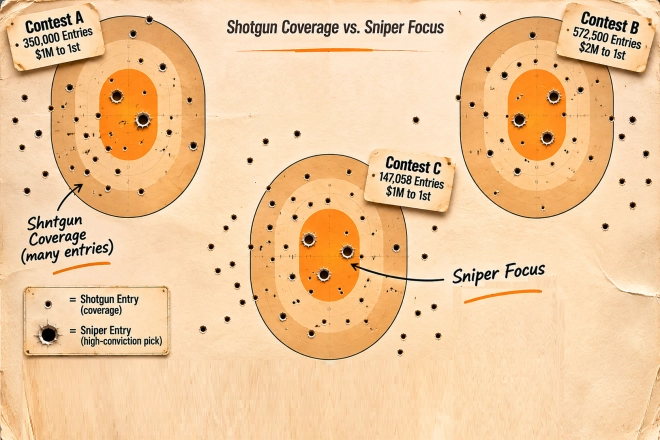
Many large DFS contests allow each contestant to enter dozens or even 150 lineups. A player using a shotgun approach uses those entries to maximize coverage across different games, teams, stacks, players and possible outcomes.
That's the shotgun.
The player spreads his shots across the slate in hopes that one or more lineups land near the top. More entries provide more coverage, but that coverage comes at a mathematical cost: as the number of entries increases, the maximum possible return relative to the total entry fees decreases.
The sniper takes the opposite approach. The sniper isn't asking: How do I maximize the chance that one of my lineups places high in this contest? He's asking: What do I believe gives me the best chance of positive long-term results?
Instead of using additional entries to buy more coverage inside the same contest, he concentrates on efficiency, taking only his strongest shot and looking for contests where that one shot has the greatest chance of producing a positive return. He literally looks for contests where other contestants use the shotgun approach..
So the important question isn't whether more entries provide more coverage. They do.
The question is: What does that coverage cost?
And here's why.
What Does More Coverage Actually Cost?
A Simple Ten-Entry Contest
Let's deliberately make the contest tiny so the principle is easy to see.
Suppose a contest has ten $1 entries, so contestants collectively pay $10. Let's assume the prizes are:
- First place: $4.00
- Second place: $1.70
- Third place: $1.30
- Fourth place: $1.00
The contest therefore returns $8 of the $10 in entry fees as prizes. The remaining $2 represents our hypothetical contest operator's fee. Actual fees and payout structures vary.
Now let's make one more simplifying assumption: every lineup in the contest is carefully constructed by an experienced player, and for purposes of this example, each lineup has an equal chance of finishing in each position.
A One-Lineup Example
With one entry, your possible return looks like this:
- 10% chance of returning 4.0x
- 10% chance of returning 1.7x
- 10% chance of returning 1.3x
- 10% chance of returning 1.0x
- 60% chance of returning 0x
Now let's assume you repeatedly enter one $1 lineup in many identical contests. Over time, you would expect to get an average of 80 cents back per contest.
You can lose everything in a single contest. However, you also have the possibility of making four times your entry fee.
A range from 4x to 0 is a very wide distribution.
Now, let's look at what happens when you add a second lineup.
Now Add a Second Lineup
Suppose instead that you buy two of the ten entries.
There are 45 different combinations* of two finishing positions. Your absolute best result is finishing first and second:
($4.00 + $1.70) ÷ $2.00 = 2.85x
There is only one first-and-second combination among those 45 possibilities*, so the probability of achieving that maximum 2.85x return is about 2.2%.
Your worst result is still zero. There are 15 ways for two entries to occupy two of the six non-paying positions:
15 ÷ 45 = 33.3%
So after adding a second lineup, your best possible return falls from 4.0x to 2.85x, your worst possible return remains 0x, and the expected return remains 0.80x.
We gained more coverage, but that coverage came at a price: our upside narrowed substantially.
At Ten Entries, Probability Disappears
Now let's take the shotgun approach all the way to its logical extreme.
If you buy all ten entries, there is no longer any uncertainty. Your coverage ensures you will finish first, but you will also finish second, third, fourth—and every other position. You will collect every prize, but you paid $10 to enter and the entire prize pool is only $8.
Your result is now mathematically certain: 0.80x return. You are guaranteed to lose 20%.
It doesn't matter how brilliantly the ten lineups were constructed or which lineup finishes first. Once you own the entire contest, the contest operator's fee determines your result.
That's an extreme example. Of course, no contestant can buy the entire field in a real 572,500-entry DFS contest. But the mathematical direction is the same.
As you purchase more coverage inside the same contest, the distribution of your possible return gets narrower around the contest's average return.
The More Coverage You Buy, the Narrower the Outcome
To summarize, as you add more lineups, what changes is the range of possible outcomes.
| Entries | Worst Possible Return | Expected Return | Best Possible Return |
|---|---|---|---|
| 1 | 0.00x | 0.80x | 4.00x |
| 2 | 0.00x | 0.80x | 2.85x |
| 3 | 0.00x | 0.80x | 2.33x |
| 4 | 0.00x | 0.80x | 2.00x |
| 5 | 0.00x | 0.80x | 1.60x |
| 6 | 0.00x | 0.80x | 1.33x |
| 7 | 0.14x | 0.80x | 1.14x |
| 8 | 0.29x | 0.80x | 1.00x |
| 9 | 0.44x | 0.80x | 0.89x |
| 10 | 0.80x | 0.80x | 0.80x |
This is the part that I find especially important.
With five entries, we have purchased half of the contest.
Our maximum possible return has already fallen from 4.0x to only 1.6x.
Yet our worst possible return is still zero.
The upside disappears much faster than the downside improves.
Contest Selection Also Matters
This is the second half of Snipe the Shotgun.
I don't just want a strong lineup. I want to put that lineup into the right kind of contest.
Consider a ten-entry single-entry contest. Every contestant gets one lineup. What lineup is each person likely to enter? The lineup he believes gives him his best chance to win.
Everyone gets one bullet, so everyone aims carefully.
Now consider a large contest where each contestant may enter 50, 100 or 150 different lineups. Many serious contestants intentionally construct portfolios for coverage. Different lineups may emphasize different games, teams, stacks, players or possible outcomes.
That difference matters mathematically.
If a knowledgeable contestant's judgment of lineup quality has predictive value—and it must for DFS strategy to have any value—then the lineup he identifies as his strongest choice should, over a sufficiently large sample, perform better than the average of all the additional lineups he creates for coverage.
The shotgun contestant doesn't have inside information about what is actually going to happen. His sophistication helps him identify possibilities and cover more of them. One lineup may be built around one game exploding offensively, another around a different game. One may emphasize one stack, while another takes a different path. Those alternatives exist precisely because he doesn't know which outcome will occur.
Some may be right. Many will be wrong.
As the number of entries increases, more lineups are devoted to those alternative possibilities. Over a sufficiently large sample, the result is a greater percentage of lineups that perform relatively poorly compared with a single-entry field where every contestant is forced to take his best shot.
There isn't some secret formula that only professional DFS players know for constructing a quality lineup. Experienced contestants may have more practice and may use sophisticated tools, but the fundamental principles of building a strong lineup can be learned. That's why we publish detailed sport-specific strategy recommendations. If you understand those principles and apply them carefully, you're equipped to construct lineups using the same fundamental strategies that experienced contestants use.
And not everyone in a huge multi-entry contest is an expert. Far from it. Large contests also attract recreational contestants who have money to spend, enjoy the action and simply want more chances to hit a big prize. Some enter many lineups without a disciplined strategy at all.
So a 572,500-entry contest isn't a field of 572,500 expertly constructed best lineups. It's a mixture of carefully constructed entries, sophisticated portfolios built for coverage, and plenty of entries from contestants who don't really know what they're doing.
That is exactly the type of field I'm looking for.
I want to take my strongest shot against a field containing a large number of lineups that exist because other contestants wanted more coverage, more action or more chances to hit the big one.
The Sniper Buys Something Different
The shotgun player is buying coverage. He knows he doesn't know exactly what will happen, so he builds lineups around competing possibilities. One game may become a shootout. Another stack may explode. A low-owned player may have the game of his life. More lineups give him more ways to cover those possibilities.
The sniper starts with a different objective: What do I believe is the strongest shot I can take?
That doesn't mean simply selecting the lineup with the highest raw projected fantasy points. Building my strongest lineup can involve stacking, player correlation, ownership, contest type and the other strategy principles appropriate for that sport. The objective is to build the lineup I most want representing me.
Then, instead of spending additional money buying more coverage inside the same contest, I look for another contest.
If I have $10 available, I don't have to buy ten different $1 lineups in one contest. I can put my strongest $1 lineup into ten different contests. The amount committed is the same, but the money is being used very differently.
The shotgun uses additional entries to purchase more coverage. The sniper uses the money to purchase additional full-strength opportunities.
That's an important distinction. Snipe the Shotgun doesn't necessarily mean risking less money because you're using fewer unique lineups. Your bankroll determines how much you're willing to commit. The number of unique lineups and the amount of money at risk are separate decisions.
Putting Snipe the Shotgun Into Practice
The exact lineup-building strategy depends on the sport and contest. That's where the ASL DFS Optimizer comes in.
Even when I want only one lineup, I can use the Multi-Lineup Generator and tell it to generate one. That allows stacking, ownership adjustments and other Pro Options to participate in building the lineup. I can also use Cyclone Mode when I want a small group of independently generated strong lineups—for example, one from each projection provider—rather than a large portfolio created simply for coverage.
The important point is that every lineup I enter should be my best shot—possibly one per projection provider—not: I need to cover another possible outcome.
Once I have the lineup or small group of lineups I want to play, I look for the shotguns. I prefer contests that allow many entries per contestant because those contests give other contestants more opportunity to spread their entries across competing outcomes.
Then I work backward from my bankroll. If I've decided to risk $20 and find twenty appropriate $1 contests, I can enter twenty times. If the contests are fifty cents, I can enter more. If they're $2, I enter fewer.
Bankroll determines how much I risk. Strategy determines what I enter. Contest selection determines where I take the shots.
That's Snipe the Shotgun.
What Happens in a Real Contest?
Our ten-entry contest was deliberately small so the mathematics would be easy to see. But the same principle applies in a real large-field DFS tournament.
In 2015, DraftKings offered a $10 million Millionaire Maker with 572,500 entries at $20 each. First place paid $2 million, second paid $1 million, and the payout structure continued through more than 125,000 positions.
With one lineup, the maximum possible return was 100,000x your entry fee, with a 1-in-572,500 chance of achieving it if every lineup were equally competitive.
Now start buying coverage.
With two lineups, your best possible result—finishing first and second—would return 75,000x your total entry fees. But the probability of occupying both top positions would be only about 1 in 164 billion.
With 10 lineups, the maximum return falls to 21,250x, while the probability of occupying all ten top positions falls to about 1 in 1.04 × 10⁵¹.
And with 150 lineups, even the impossible dream result of finishing first through 150th would return only about 1,669x the $3,000 invested. The probability of actually occupying all 150 of those positions would be roughly 1 in 7.96 × 10⁶⁰⁰.
Of course, entering 150 lineups makes it more likely that one of them finishes first. That's what the shotgun player is buying.
But look at what happens to the economics of the entire portfolio: the more coverage you buy, the lower your maximum return relative to everything you spent, while the probability of achieving that maximum portfolio result collapses even faster.
That's the tradeoff I want to avoid.
Aim Carefully
Snipe the Shotgun isn't about finding a magical lineup that can't lose. Sometimes the sniper misses. That's DFS.
It's about making deliberate decisions with both your lineup and your money. Control your bankroll. Build the strongest lineup you can. Choose contests where other contestants are spreading their entries across many possible outcomes. Then give your best shot multiple opportunities to work.
The shotgun tries to cover the target. The sniper tries to hit it.
That's Snipe the Shotgun.
---
*Why 45 possibilities? With two entries in a ten-entry contest, the first finishing position can be paired with 9 others, the next with 8 remaining positions, then 7, and so on. So the number of unique finishing-position pairs is 9 + 8 + 7 + … + 1 = 45.
