
Most of the month, my head is down. I am buried in product development, software architecture, testing, customer support and all the technical details required to move ASL forward. I rarely stop long enough to look at the whole picture.
Writing From the Desk gives me an excuse to poke my head up once a month and ask: Where are we now, and where are we going? Looking back, 2026 seems to have gone incredibly fast — but so has ASL’s progress. It feels really good to see plans we began putting together in 2025 actually taking shape in 2026, with the potential to make a real impact in 2027.
October was an especially good month to look up. The first pass of The Machine’s rebuilt user interface is complete. Several important pieces of the infrastructure underneath our products are now coming together. And while we build toward the future, the current DFS Optimizer continues to get stronger.
The Machine Has Its Face Back
This is the update I know many longtime ASL customers care about most.
We have now reconstructed more than 50 legacy pages of The Machine in a modern technology environment. These pages support the decisions fantasy team managers need to make before the draft, during the draft, and throughout the season — from pre-draft trades; to redraft, dynasty and auction drafts; to lineup, waiver and trade decisions. They support a very broad range of league types while displaying the probability information that helped make the original Machine unique.
You can actually explore the rebuilt pages now at TheMachine.run.
The pages look real because they are real — but there is an important distinction. Right now, they are operating with sample data. The databases, calculations, fantasy-provider connections and other systems behind those pages still need to be connected before The Machine becomes a functioning product again.
We have rebuilt The Machine’s face. Now we are moving behind the screens and reconnecting the systems that make it think.
That work will restore the original product functionality, but it also gives us the foundation for something much bigger. Once the NFL version is functioning again, the plan is to expand The Machine to NBA, MLB and NHL, incorporate our next-generation mathematics, and continue modernizing the product from there.
The recipe was never lost, but now the lights are back on in the kitchen.
Now We Are Building the Engine Room
In October, we moved a major piece of ASL’s engine room into production — our new Customer Support / Exception Trapping system — and started work on two of the three remaining infrastructure pieces: moving the DFS Optimizer’s data-preparation process to a more efficient application server, and building a common framework for running and coordinating cloud-based software functions.
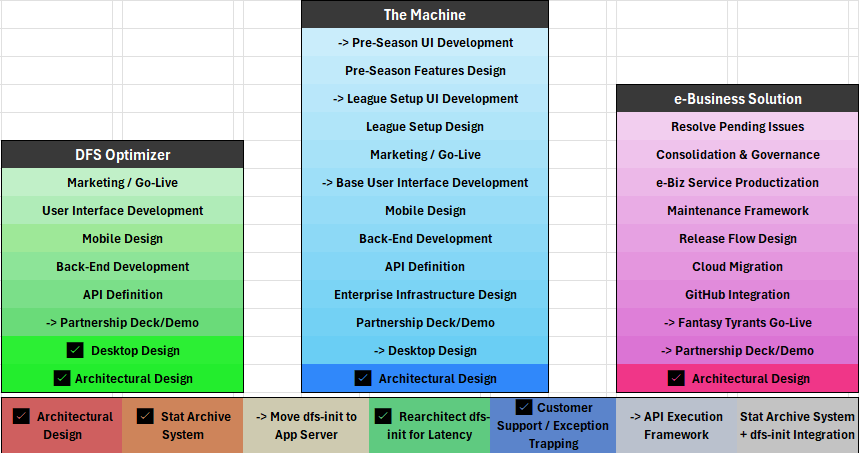
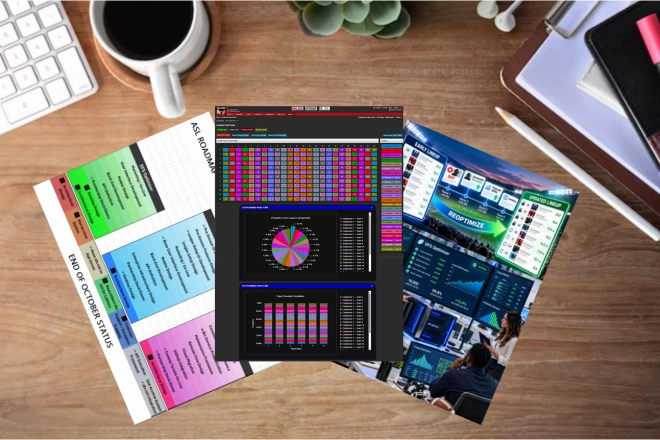
The horizontal track along the bottom of the roadmap represents this shared infrastructure. It sits underneath The Machine, the DFS Optimizer and the e-Business Solution, providing systems that all three product lines can use.
Our new Customer Support / Exception Trapping system modernizes how ASL captures, routes and manages software errors across its products. More importantly, it gives us a stronger foundation for gathering additional information from customers when needed and communicating with them as an issue is being investigated and resolved.
The architecture is also designed for the newer cloud-based systems ASL is building. Instead of requiring everything to run continuously through a traditional server, applications can increasingly directly send work into the Microsoft Azure cloud when it is needed and receive the results back. This makes the underlying systems more flexible and better suited to the next generation of ASL products.
The two infrastructure projects now underway continue that transition. One moves the DFS Optimizer’s data-preparation work into a more efficient application environment. The other creates a common framework for running and coordinating the cloud-based functions that will increasingly power ASL’s products.
Think of all of this as the engine room underneath the products. Customers may never see most of it, but The Machine, the DFS Optimizer and everything else ASL builds will run better because it is there.
Battle-Hardening the DFS Optimizer
While much of ASL’s development is focused on The Machine and the infrastructure behind our next generation of products, customers using the DFS Optimizer today are also seeing steady improvements.
October brought improvements to overall reliability, slate rules, saved lineups, automatic reoptimization and several of the optimizer’s strategy controls. We also continued refining tools for building multiple lineups and controlling player exposure — features that become increasingly important as a customer moves beyond simply generating one optimal lineup.
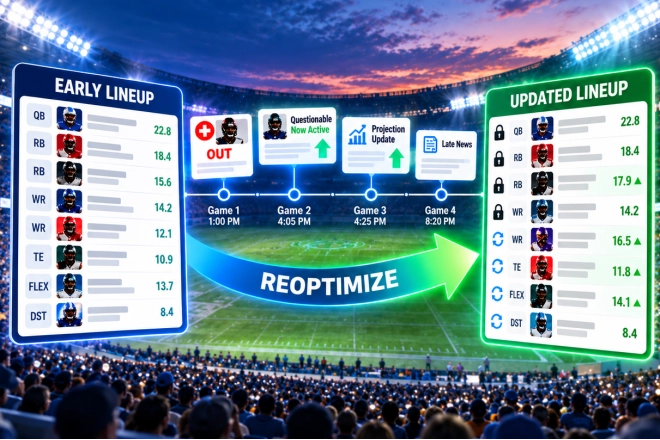
Reoptimization has been another major area of attention. As a slate unfolds and games begin to lock, the optimizer needs to preserve players who can no longer be changed while intelligently rebuilding the portions of a lineup that are still available. We have continued strengthening that process, including the automatic reoptimization features designed to react to changing information later in a slate.
Interestingly, the weekly instructional articles I have been writing are helping drive some of these improvements. When I build realistic examples to explain features such as multiple-lineup strategy, maximum and minimum exposure, or reoptimization, I sometimes find opportunities to make the underlying tools better. The articles therefore help customers get more out of the optimizer while also helping us improve the product itself.
Behind the scenes, our automated testing has also become much stronger. Before changes are released, hundreds of tests can now verify that existing functionality still works as expected. For a product with as many interacting settings and strategies as the DFS Optimizer, that gives us much greater confidence that an improvement in one area does not create a new problem somewhere else.
The Roadmap Is Starting to Come Together
When I look at ASL’s roadmap now, I see something different than I saw a year ago. The three main product tracks are still there:
- The DFS Optimizer
- The Machine
- The e-Business Solution
But underneath them is a growing layer of shared infrastructure that all three can use. That is important because we are not building three unrelated products from scratch. Increasingly, they can share cloud-processing systems, support tools, data systems, development infrastructure and other technology.
October brought three particularly visible changes to that roadmap:
- The first-pass reconstruction of The Machine’s legacy interface is complete.
- The new error-reporting and support foundation moved into production.
- Additional shared infrastructure projects are underway to improve data preparation and coordinate cloud-based processing.
As those common systems are completed, development can increasingly move upward into the products themselves. That is when the roadmap should become much more visible to customers.
What Comes Next
For The Machine, the next job is straightforward to describe even though it is not simple to build: make the pages work. That means reconnecting the calculations, databases, provider integrations and other systems behind the interface until the rebuilt Machine becomes a functioning product again.
For ASL’s shared infrastructure, the goal is to keep knocking down the foundational pieces that multiple products need. And for the DFS Optimizer, we will continue battle-hardening the current product while gradually moving toward its next generation.
The longer-term direction has not changed. I want to restore The Machine, extend it beyond NFL, continue advancing the DFS Optimizer, and build all of ASL’s products on a stronger common technology foundation.
But the difference today is that these things no longer feel like distant plans on a whiteboard. You can see The Machine again. You can see the DFS Optimizer improving. And underneath both of them, the systems needed to support what comes next are being built.
When I finally poke my head up and look at the whole picture, that is what makes October feel significant. The plans are turning into products.
And I am very much looking forward to seeing what they become in 2027.
